This article contains eBay affiliate links. If you buy through them, we may earn a commission at no extra cost to you.
The answer in three questions
- Does your turntable have a built-in preamp? Look for a PHONO/LINE switch on the back, or check the spec sheet. If yes, and it's switched to LINE, you don't need another preamp. Plug into powered speakers or any line input.
- If not, does your amplifier or receiver have a PHONO input? If yes, you don't need another preamp. Plug into PHONO, and connect the ground wire if there is one.
- Neither? Then you need a phono preamp. It sits between the turntable and your speakers or amp.
Why turntables need a preamp at all
Two reasons: the signal is tiny, and it's deliberately "bent."
The signal is tiny
A cartridge generates electricity from the stylus moving in the groove, and it doesn't generate much. Moving-magnet (MM) cartridges typically put out a few millivolts. Ortofon lists the 2M Red at 5.5 mV, and Audio-Technica lists the AT-VM95E at 4.0 mV. Low-output moving-coil (MC) cartridges produce only a few hundred microvolts. Denon lists the DL-103 at 0.3 mV. That's far below what a normal line input expects, so it needs boosting.
The signal is equalized
Records are cut with the bass turned down and the treble turned up, following a standard curve set by the RIAA (the record industry's trade body) that has been the norm since the 1950s. Cutting it that way lets grooves fit more music and keeps surface noise in check. On playback, the phono stage applies the opposite curve to restore the original balance. A plain amplifier can't do that. Only a phono stage does.
Where a phono preamp can live
| Where | How you'd know | Plug into |
|---|---|---|
| In the turntable | PHONO/LINE switch on the back; spec sheet says "built-in preamp" | Powered speakers, soundbar AUX, any line input (switch set to LINE) |
| In the amp or receiver | An input labeled PHONO, usually with a GND terminal next to it | The PHONO input (turntable's own preamp off, if it has one) |
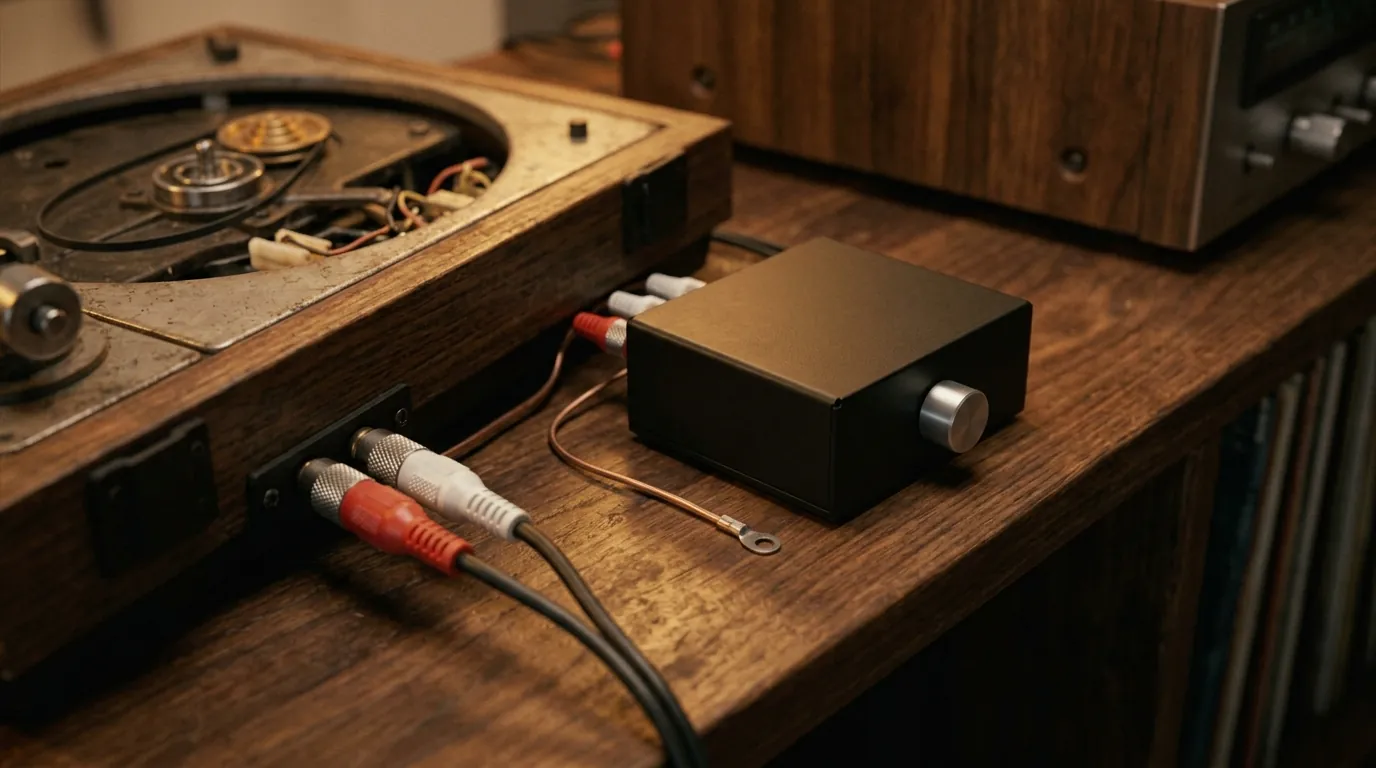
| A separate box | A small unit with PHONO IN and LINE OUT | Turntable → preamp → any line input |
Many beginner decks, like the Audio-Technica AT-LP60X and Fluance RT81, have a built-in switchable preamp. Many hi-fi decks, like the Pro-Ject Debut Carbon EVO and Rega Planar 1, don't. Rega's Planar 1 Plus adds one. Vintage stereo receivers commonly include a phono input.
Three common hookup mistakes
- No phono stage at all. Quiet, thin, bass-less sound. Switch on the deck's preamp or use a PHONO input.
- Two phono stages. Loud, harsh and distorted. Turn one off.
- An MC cartridge on an MM-only stage. Very quiet with a lot of hiss once you turn it up. Low-output MC cartridges need an MC-capable phono stage.
And if you hear a steady hum, check the ground wire. It should run from the turntable to the GND terminal on your amp or preamp.
Buying a phono preamp on eBay
Match the preamp to your cartridge type. For most people that's MM, the type fitted to most beginner and mid-range decks. If you have (or plan to get) a moving-coil cartridge, look for a stage that lists MC support. Check the listing includes the power supply, and ask the seller to confirm both channels work.
Search phono preamps on eBayNew and used MM and MM/MC phono stages.eBay affiliate link
Search eBay