This article contains affiliate links to eBay and Amazon. As an eBay Partner and an Amazon Associate, we may earn from qualifying purchases at no extra cost to you.
- You need exactly one phono stage between the cartridge and the speakers.
- Powered speakers have their own amplifier; passive speakers need an amplifier or receiver.
- A deck with a built-in preamp can feed powered speakers directly through a line input.
- A deck without a preamp needs a PHONO input or a separate phono preamp first.
- Some powered speakers include a phono input; confirm that on the spec sheet.
The rule behind every hookup
A turntable's signal is tiny and equalized, so something in the chain has to boost it and undo the equalization. That something is a phono stage, and you need exactly one: none and the sound is thin and quiet, two and it is loud and distorted. Our preamp guide explains why, and the rest of this guide uses it.
So the first question is not which speakers, but where the phono stage is. It might be in the turntable, in a receiver, in the speakers or in a small box of its own. Once you know, the choice of speakers is a matter of matching inputs.
Which speaker type connects to which turntable
| Your turntable | Powered speakers | Passive speakers |
|---|---|---|
| Built-in preamp, switched to LINE | Plug into the speakers' line input | Plug into an amplifier or receiver's line input, then the speakers |
| No preamp | Needs a phono preamp first, unless the speakers have a PHONO input | Plug into a receiver or amplifier with a PHONO input, or add a phono preamp first |
| Bluetooth deck | Pair with a Bluetooth speaker, or use the wired output | Wired outputs to an amplifier, if the deck has them |
If you see a PHONO input on a receiver or on some powered speakers, that input includes the phono stage and the deck's own preamp should be off. If the input is labeled AUX or LINE, it has no phono stage and the deck's preamp must be on or a separate preamp must come first.
Powered and passive speakers
Powered speakers
Powered speakers, sometimes called active speakers, have an amplifier built in. They plug into the wall and take a line-level signal from the deck, which makes them the simplest pairing for a turntable with a built-in preamp. Look at the listing for the input type, usually RCA or 3.5 mm, and confirm the cable you need. Some powered speakers also include a phono input, which would let you use a deck without a preamp. Not all do, so confirm it on the maker's spec sheet and do not assume.
The deck's own preamp should be switched on only if you connect to a line input. If you connect to a PHONO input, turn the deck's preamp off. The beginner turntable guide lists decks that plug straight into powered speakers.
Search powered speakers with RCA inputsCheck the listing for the input types and whether it names a PHONO input before you buy.Amazon affiliate link
Search AmazonPassive speakers
Passive speakers have no amplifier. They need an amplifier or receiver that sends them speaker-level power through speaker wire. That makes them a natural pair for a vintage receiver, which often includes a PHONO input, so the deck can plug in directly. Used passive speakers are plentiful on eBay, and receivers are too.
When buying a used receiver, ask about the PHONO input, the speaker terminals and the condition of the switches and knobs, and check that its power rating suits the speakers you plan to use. Match them using the maker's information, and do not open a receiver while it is plugged in. Mains-powered servicing belongs with the manual and a qualified technician.
Search receivers with a phono input on eBayLook for listings that mention a PHONO input and show the back panel clearly.eBay affiliate link
Search eBayCables and other connections
- RCA cables carry the deck's signal to a preamp, receiver or powered speaker. Left and right are color-coded.
- 3.5 mm to RCA adapts a deck's output to some speakers and soundbars with a 3.5 mm input.
- Speaker wire connects an amplifier or receiver to passive speakers. Keep the polarity consistent at both ends.
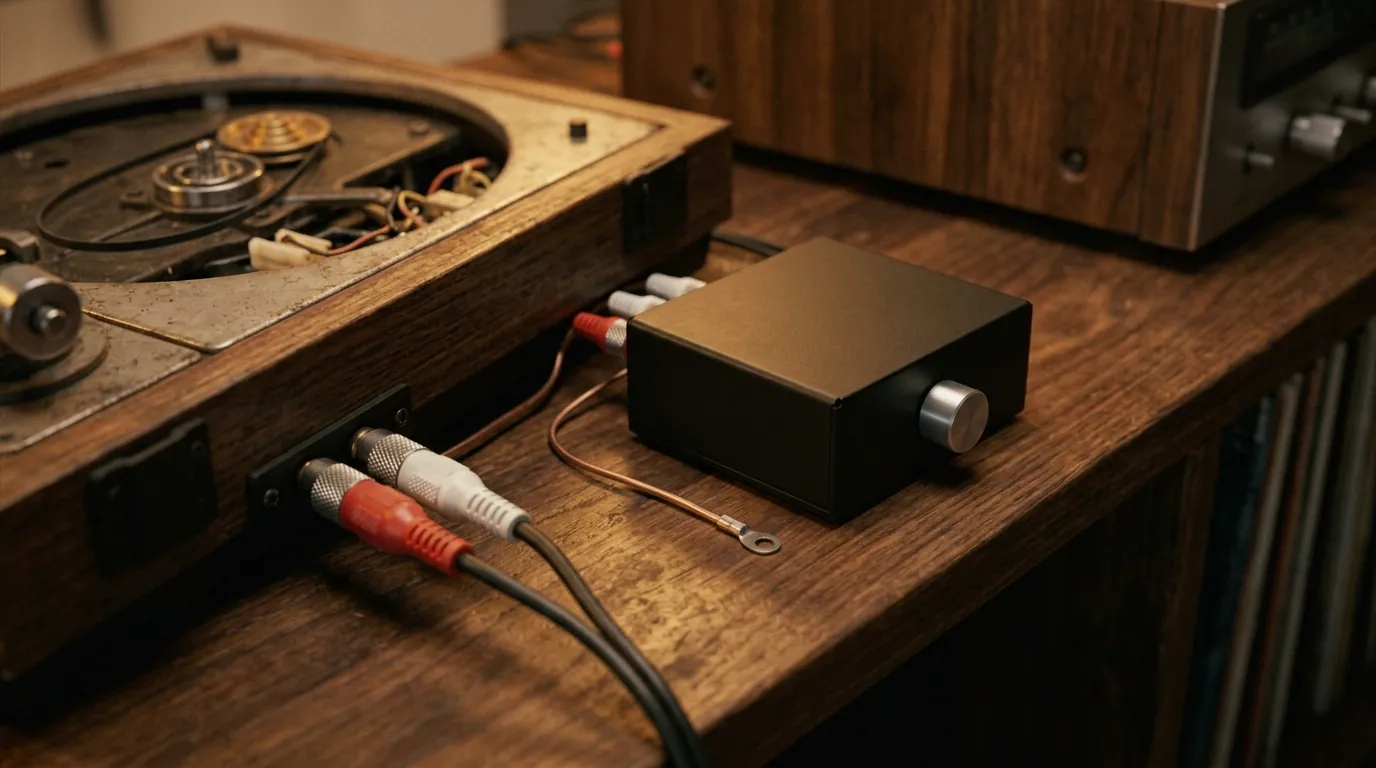
- Ground wire runs from the deck to the GND terminal on a receiver or preamp to prevent hum. If your deck has one, attach it.
Search RCA to 3.5 mm audio cablesCheck the connector types at both ends and the cable length against your setup.Amazon affiliate link
Search AmazonSoundbars, Bluetooth speakers and other options
A soundbar with an AUX or optical input can work with a deck that has a built-in preamp, as long as the input is a line input, not a PHONO one. A Bluetooth speaker works with a Bluetooth turntable, or with a wired deck plus a Bluetooth transmitter after a phono stage, as we explain in our Bluetooth turntable guide. Headphones can connect through a receiver or preamp with a headphone output.
Placement: keep speakers off the deck's shelf
Speakers make sound and vibration, and a turntable's stylus is sensitive to both. If the speakers sit on the same shelf as the deck, vibration can feed back through the plinth and show up as a boomy, muddy sound or even a howl when you turn it up. Put the speakers on their own stands or surface, away from the deck, and put the deck on a stable, level surface. Our mat guide covers one small way the platter surface affects the record.
Leave enough cable length to place the speakers where you want them. Powered speakers need a power outlet each, or one of the pair powers the other through a cable, so check the layout before you buy.
Buying used speakers on eBay
Used speakers are heavy and fragile to ship, so ask how the seller will pack them. Ask for photos of the drivers and the terminals, and ask whether any cone is dented, torn or rubbing. For passive speakers, ask whether both work, since photos cannot show a blown driver. For powered speakers, ask whether the amplifier hums, crackles or cuts out. Then check the return policy and who pays shipping if there is a fault.
Common mistakes
- Plugging a deck without a preamp into a plain AUX input. The result is quiet and thin.
- Leaving the deck's preamp on while using a PHONO input. The result is loud and distorted.
- Buying passive speakers without an amplifier to drive them.
- Forgetting the ground wire, which can leave a steady hum.
- Assuming powered speakers include a PHONO input without checking the spec sheet.
For a full list of what a starter system needs, see our starter setup guide.
How to choose
If the deck has a built-in preamp and you want simplicity, buy powered speakers and one cable. If you like vintage gear or want room to upgrade, buy a receiver with a PHONO input and a pair of passive speakers. If the deck has no preamp and you want powered speakers, add a phono preamp or find speakers that list a PHONO input. In each case, check the input labels on the equipment you are actually buying.
Sources and verification
The hookup rules follow this site's existing preamp guide, which we read in full. The statement that some powered speakers include a PHONO input is a general observation, and we did not verify it for any specific model, so check the spec sheet. We make no claim about power ratings or speaker matching; use the makers' information for that.
- RecordPlayers.co: Do you need a phono preamp? (one phono stage, PHONO vs LINE inputs, ground wire)
- RecordPlayers.co: What you need to play records beyond the turntable
- Your receiver, speaker and turntable manuals for input labels, power ratings and ground connections.