This article contains affiliate links to eBay and Amazon. As an eBay Partner and an Amazon Associate, we may earn from qualifying purchases at no extra cost to you.
- Every setup needs exactly one phono stage: in the deck, in the receiver, or a separate box.
- Powered speakers are the easiest route; passive speakers need an amplifier or receiver.
- Check cables, the ground wire and the input labels before you wrap.
- Include a brush and at least one record to play first.
- Vintage receivers need checking by a qualified technician; follow the manual for power and voltage.
The signal chain, in plain terms
A turntable makes a very small signal. To turn it into sound, that signal has to pass through a phono stage (the preamp that boosts it and applies the correct equalization), then an amplifier, then speakers. Sometimes those parts are built into one box and sometimes they are separate. Our phono preamp guide explains the one rule: you need exactly one phono stage in the chain.
Gift-givers trip over this, because "record player" can mean anything from a suitcase unit with a speaker to a hi-fi deck with nothing built in. The table below shows what each type needs.
| The deck is... | It already has | You still need |
|---|---|---|
| An all-in-one with built-in speakers | Phono stage, amp and speakers | Records and basic care. Quality is limited by the built-in parts |
| A deck with a built-in switchable preamp | A phono stage | Powered speakers, or an amp and passive speakers, plus cables |
| A deck with no preamp | Nothing beyond the arm and cartridge | A phono input on an amp or receiver, or a separate phono preamp, plus speakers and cables |
Three starter setups that work
- Deck with preamp plus powered speakers. The simplest route. Set the deck's preamp switch to line, plug into the speakers, play. Check the speakers have the right input and the cables to connect them.
- Deck without preamp plus a receiver with a phono input. A classic hi-fi arrangement. The receiver's PHONO input does the preamp job, so you also need passive speakers and speaker wire.
- Deck without preamp plus a separate phono preamp. This lets a basic deck feed powered speakers or any line input. Match the preamp to the cartridge type, as the preamp guide explains.
If you are giving the whole setup, choose one path and buy to it. Plugging a deck into a PHONO input with its own built-in preamp switched on is a common mistake, as it puts two phono stages in the chain. A Bluetooth speaker only works if the deck sends Bluetooth or the speaker has a wired input, so check before you rely on one. Read the beginner turntable guide if you still need to choose the deck.
Speakers, amplification and cables
Powered (active) speakers have an amplifier built in, so they plug straight into a line-level source. Passive speakers need a separate amplifier or receiver and speaker wire. Some powered speakers include a phono input, but many do not, so confirm in the spec sheet. A used receiver can be a bargain starting point if it has a PHONO input, but vintage equipment should be checked by a qualified technician before use, and electrical questions belong with the maker's manual.
Browse powered speakersLook for the inputs you need (line or phono) in the listing before you buy.Amazon affiliate link
Search AmazonCables, ground wire and the small things
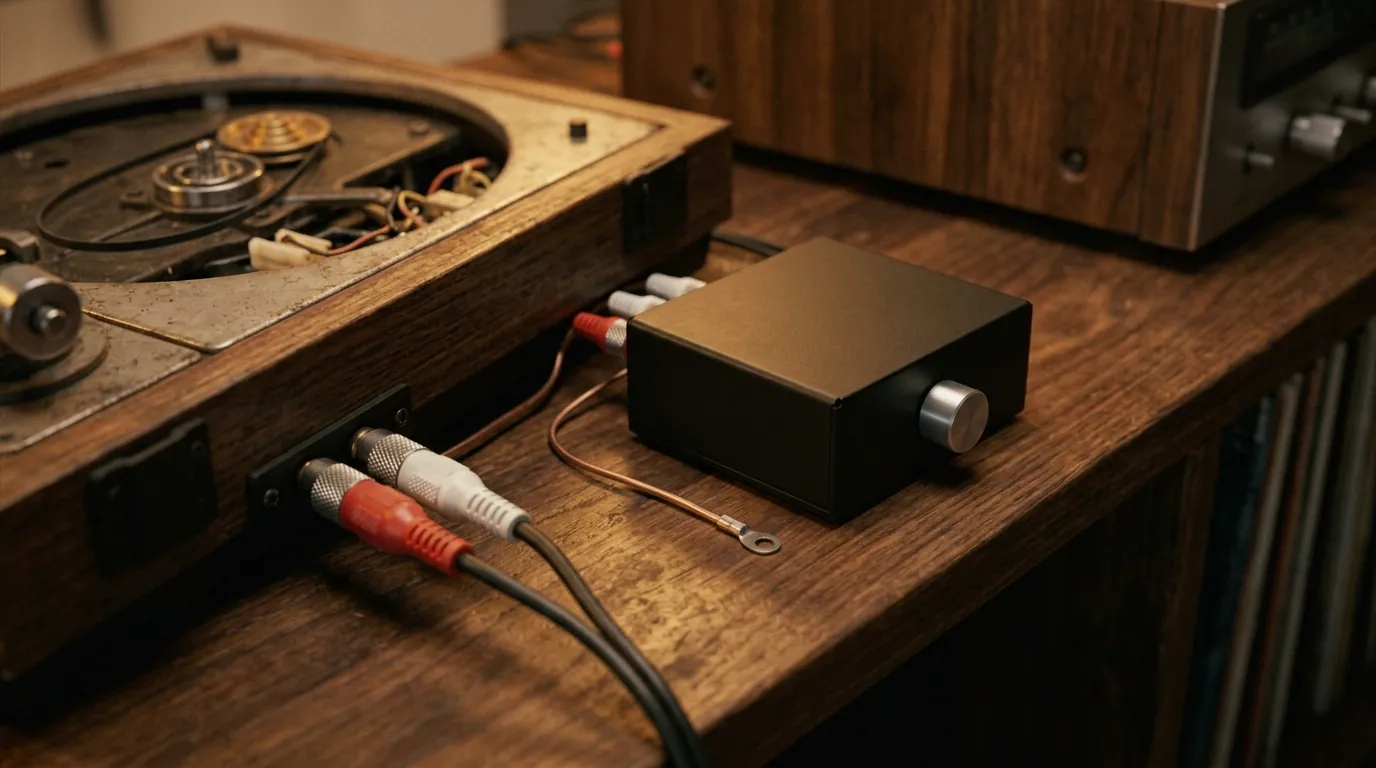
Most decks connect with a pair of RCA cables, and many have them attached. Some decks also have a thin ground wire that must go to the GND terminal on the amp or preamp. If a connected deck hums, check the ground first. A deck with detachable cables needs a pair in the box.
Then the unglamorous items that make the first evening go well: a firm, level surface that does not shake when you walk past, a spare power outlet, and enough space for the dust cover to lift. A level shelf away from the speakers helps avoid vibration.
Search cablesRCA cables and basic hookup parts.Amazon affiliate link
Search AmazonCleaning and records
A starter gift is not complete without something to play and something to keep it playing. A cleaning brush for records, a stylus brush, and a few records the person loves matter more than a fancy extra. Our guide to turntable accessory gifts covers care items, and the stylus guide explains when a stylus wears out.
For a used deck, include the replacement you expect to need first, which is usually a stylus or a belt. See giving a used turntable as a gift for the checks that come before wrapping.
Looking for a vintage receiver?Search stereo receivers, then check the listing for a PHONO input and what the seller says about testing.eBay affiliate link
Search eBayWhere to spend first
If the whole setup has to fit a fixed budget, protect the parts that decide whether it works at all. Get a complete, correctly matched signal chain first. Then put the next amount into the speakers, because they shape what you hear more than a small accessory does. Cables, sleeves and extras come last.
An all-in-one player is the simplest way to get sound out of a record, but its built-in speakers and arm limit what you can improve later. A component setup costs more up front and can be upgraded one piece at a time. Neither is wrong, and the right one depends on how seriously the person will take the hobby. If you are unsure, start with a deck that has a built-in preamp, since it works with powered speakers now and with a proper amp later.
A final checklist before you wrap
- Is there exactly one phono stage in the chain?
- Do the deck outputs match the amp or speaker inputs?
- Do you have the cables, power supplies and speaker wire?
- Does the recipient have somewhere stable to put it?
- Is there at least one record to play first?
Sources and verification
Phono stage and hookup rules follow the site's own preamp guide. We did not quote any manufacturer specification. Confirm inputs, voltages and cable types in the manuals for your own equipment.
- RecordPlayers.co: Do you need a phono preamp? (one phono stage per chain, built-in preamp switch, PHONO input, ground wire)
Electrical safety and mains-voltage matters are for the equipment manual and a qualified technician. No prices or stock levels are claimed.